
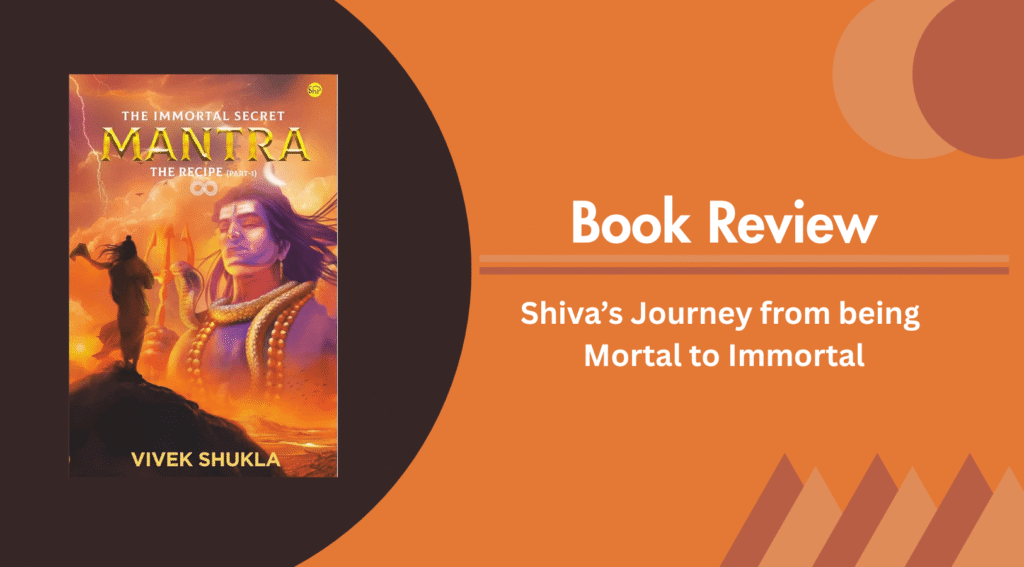
While we often visualize Shiva as a Yogi, the cosmic dancer Nataraja, or the Ardhanarishwara embodying both man and woman, a captivating analogy paints him as a simple farmer who unlocked the path to immortality. This article explores Shiva through the lens of author Vivek Shukla, revealing a relatable and profound perspective on his divine journey. In his book The Immortal Secret — Mantra the Recipe many dimensions would open up in your heart and mind and you will fall in love with depth of information and knowledge the author has.
Why Shiva is a Farmer?
As per the hindu text, the month Shraavana (Monsoon) is dedicated to Lord Shiva. Legends say that Goddess Paravati carried out hard penance during this time to please Lord Shiva to marry her. Pleased by her dedication and devotion, Lord Shiva married her during the sawan month. Another tales suggests that, during Amrit Manthan (the cosmic churning of the ocean) Shiva consumed the poison that came out from the ocean floor. To remove the ill effects of the poison the devas performed Jalabhishek which incidentally happened in the month of sawan. However, for the farmer it’s the rains/ monsoon that holds a deep significance. For a farmer, lack of rain spells disaster, highlighting the importance Shiva grants this life-giving element.
It is observed that Lord Shiva has a serpent coiled around his neck. There are many tales which talks about what does the snake represent. Some says it defines endless cycle of birth and death, some say it defines Ego — it recoils when poked and spreads to attack, similarly we get our ego if poked unnecessarily. But for a farmer, snakes are their best allies. They eat away the rats and rodents who harm the crops in the field.
Shiva carries a trishul with him to fight the demons. But many tales represent trishul as three fundamentals of life like — ida, pingala and shusma nadi or state of consciousness like — waking, dreaming and sleeping or the three gunas like — satva, rajas and tamas. There are more such representation of trishul but for a Farmer this trishul represents three difficulties of life.
1. Drought — If there is no rainfall for a long period of time and there is lack of fresh water resource, crops won’t grow.
2. Floods — Excess of water will demolish the crops
3. Insects — Different kinds of insects / locusts that harm the crops
So, for the first two issue Shiva has given us the river Ganga. When there is no rainfall a farmer has a useful source of water body — river. So, this would at least ensure there is no drought on the plain. To ensure there are is no flooding, Lord Shiva has balanced the flow of the river currents by holding on Ganga on his head and letting it flow gently.
Finally, to prevent the crops being affected by insects — Shiva plays damru. The sounds and the vibrations irritate the ear and they try to move away. A perfect example of this is during the covid times (2020). There was a locust attack along the western northern regions of our country. The farmers were advised to beat drums and loudspeaker and make sound using utensils as well to repel the swarms. We did it too to appreciate our health workers effort but there is a science related to sound and frequencies. Hence as a farmer nothing can be best but a damru for Shiva.
Does all of this resonate with you?
I am sure it’s difficult to conclude how an ordinary human became Shiva. I guess, if I connect the dots with Jainism, it makes sense. Jains believe every soul can attain liberation (moksha) through right perception, right knowledge and right conduct. And it is believed that the first tirthankara Rishabhnatha was no other than Shiva himself also called as Adinath. This simply means Shiv worked on himself and slowly crafted a path from being a mortal to immortal through rightful means. Similarly, the author has given a lovely analogy of the path to immortality.
He says our human body is perishable just like milk whose shelf life is a day. For the milk to become nonperishable it has to go through a process of change. And that change is slow and steady process. Let’s say the we convert the milk in to curd the life span improves from 1 day to 2–3 day. Later you can convert the curd into buttermilk/lassi having a better life span. You then convert the buttermilk into butter which has a life span 3–4 weeks and finally you can transform the butter into ghee which is immortal as ghee typically does not decay. Similarly, Lord Shiva being as ordinary as you and me, found out the path for his soul from being mortal to becoming immortal. Though, the steps of achieving this “siddhi” are in our religious text in an unstructured form — Some decoded, some not understood, some still a mystery somewhere. But for us layman, this analogy of Shiva as a farmer blossoming into Mahadeva holds a beautiful, resonant truth.
If this resonated with you, delve deeper into Vivek Shukla’s “The Immortal Secret — Mantra the Recipe” and embark on your own exploration of this profound path.
For more such book reviews click here