
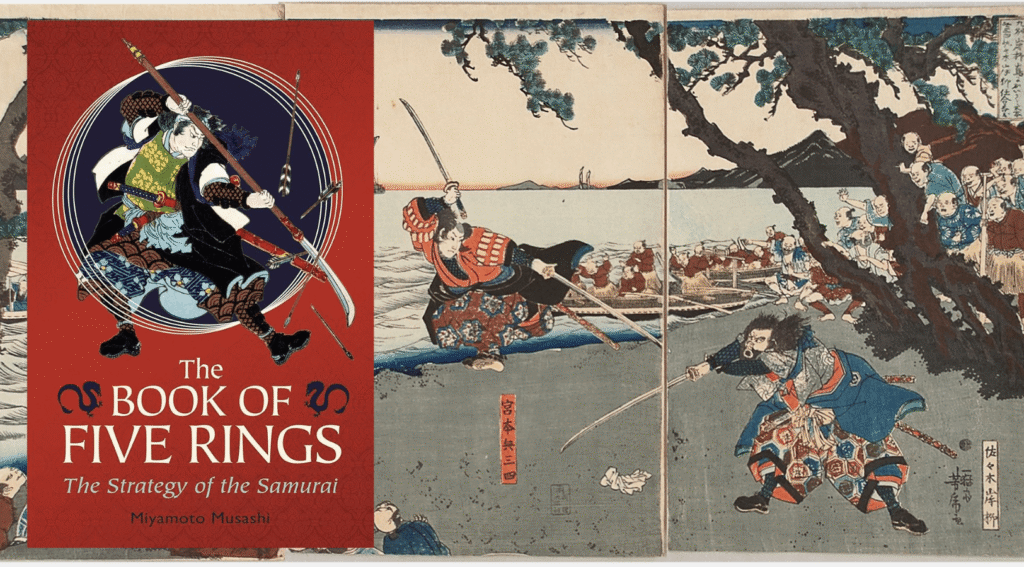
There is a rare kind of silence that only exists before sunrise, when the world has not yet decided who you need to be for the day — a silence soft enough to hear your own soul shift, to notice a thought blooming before the noise of life rushes in and steals it away — and discovering The Book of Five Rings feels like stepping into that sacred hush, where wisdom that has traveled across centuries finally slows down long enough to sit beside you.
When you imagine a samurai, you probably picture clashing metal, fierce eyes, and the kind of certainty that doesn’t tremble — but Miyamoto Musashi was nothing like the glorified warriors in painted scrolls or polished legends; he was a wanderer with dust in his hair and solitude stitched into the seams of his life, a man who built his existence not on admiration but on necessity, dueling strangers not to prove his strength but to understand what strength truly was, and after sixty unbeaten battles, after offering decades of his life to the edge of a blade, he realised that victory over others means very little if the war inside you remains unsettled.
So Musashi left the world that applauded him — not in search of comfort, but in search of truth; he chose a cold cave over crowded arenas, chose silence over cheers, chose reflection over reputation, because some lessons only arrive once you are brave enough to be alone with them, and in that quiet stone shelter, he began writing not as a warrior preparing students for battle, but as a human finally ready to lay down the heavy armor he once mistook for identity.
Where a Warrior Becomes a Philosopher…
The words he wrote did not come from theory or philosophy — they came from scars, from instinct, from moments when survival depended on a breath’s worth of awareness — and he shaped them into what he called the Five Rings: Earth, Water, Fire, Wind, and Void; not elements as the world teaches them, but states of being, ways to navigate both the world outside and the storms within, paths that lead not to dominance, but to clarity.
He began with the Earth, because Musashi understood that before a person can rise, they must learn how to stay — how to root themselves in what is real instead of drifting through life on borrowed purpose; Earth is where routines become resilience, where discipline becomes love in disguise, where a solid stance becomes a steady heart, and Musashi, who once walked into duels with nothing but determination holding him up, insists that greatness is quietly built in the hours when no one is watching.
From that steady ground, he flows into Water — the teacher of adaptability — because he knew that rigidity is another name for fear, that those who refuse to change eventually shatter under the weight of life’s unexpected tides; Water moves through obstacles not by force but by understanding their shape, offering us the wisdom that flexibility isn’t weakness — it is the only kind of strength that survives everything.
Then comes Fire — a force that does not wait for permission — and you can hear Musashi’s memories in every flame as he writes of intuition, urgency, and the kind of presence required when life asks you to act before doubt can tighten its grip around your courage; Fire is that split-second decision when destiny tests whether you trust yourself enough to leap without looking back.
But fire, if held too long, burns the very hand that wields it — and so Musashi calls in the Wind, a reminder that identity expands when we allow our curiosity to wander, when we stop guarding our own ways so fiercely that no new wisdom can enter; Wind travels across philosophies, cultures, and beliefs, teaching us that understanding another is not a threat to our truth — it is how our truth grows wider.
And finally, Musashi brings us into the Ring of Void — the most mysterious, the most misunderstood — a space not of emptiness, but of essence, where thought becomes quiet enough for insight to reveal itself, where the self dissolves just enough for us to feel connected to everything; Void is that difficult-to-describe moment when clarity arrives without explanation, when you suddenly know what you must do, simply because all the noise that once said “you can’t” has fallen away.
As you read him, something inside you shifts — slowly, but undeniably — because Musashi is not telling you how to fight others, he is showing you how to stop fighting your own shadow; every duel he ever won becomes a metaphor for conquering fear, hesitation, pride, distraction — the invisible enemies that steal our lives long before death ever reaches us.
And when the final page turns, you realise that this is not a book about swordsmanship, but about self-awareness sharpened until it becomes a blade of its own; you realise that Musashi was never trying to create more warriors — he was trying to create people who are no longer at war with themselves; you realise that the fiercest courage is not found in striking down opponents, but in rising from your own doubt, again and again, until doubt no longer recognises you.
Because the greatest victory is the moment you understand that you do not need to win against the world — only within yourself. And maybe that is why Musashi’s voice still reaches us across lifetimes — because every one of us, in our own quiet battles, is searching for the same peace he found in that cave:
the peace of knowing that nothing outside you has more power than what you choose to believe inside you.
Why This Book Finds You Exactly When You Need It
The Cosmic Stories urges you to read this book — not because it is ancient, or famous, or celebrated by those who speak of combat as though it were a sacred art, but because Musashi speaks to the part of you that is constantly wrestling with doubt, constantly trying to belong, constantly torn between who you are and who you want to be. We believe that a book only earns its place in your life when it shifts something inside you — and The Book of Five Rings doesn’t just shift, it sharpens; it doesn’t just inspire, it awakens. There is a calm courage that grows in you as you walk alongside Musashi’s wisdom — the kind that does not shout or sparkle or seek validation, but the kind that lets you stand in your truth without apology, without fear, without needing the world’s permission to exist exactly as you are becoming.
Interested in reading another book recommendation – Check out – The Immortal Secret : Mantra the Recipe